
- Adrian's Blog
- Log in or register to post comments
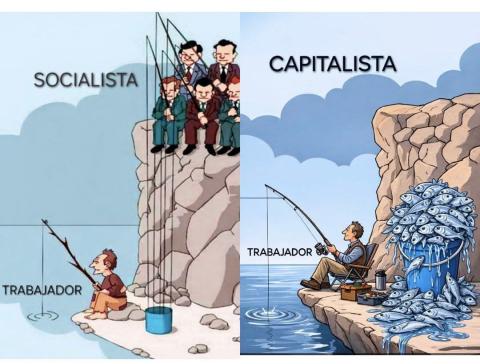
In the world of economic propaganda, visual metaphors are powerful tools. One common illustration used to defend capitalism depicts a stark contrast: On one side, a worker fishes into a bucket, but a group of "collectivists" stands above him, their lines cast into his bucket to steal his catch. This is labeled "Socialism." On the other side, the worker stands alone, his bucket overflowing with the fruits of his own labor, undisturbed and prosperous. This is labeled "Capitalism."
It is a compelling image of fairness and self-reliance. The only problem is that it is a fiction. It assumes that the "water" is always accessible and that the only threat to a worker’s bucket is the government. In reality, "True Capitalism" isn't about the fisherman’s bucket at all—it is about who owns the lake.
The Missing Fence: From Markets to Monopolies
The flaw in the "overflowing bucket" imagery is that it removes the most important variable: The Fence.
If we were to draw an honest representation of capitalism in its purest form, the worker wouldn't be standing on an open shore. He would be standing in front of a 100-foot-tall steel fence. The capitalist isn't interested in fishing from the worker’s bucket; the capitalist has bought the entire coastline. By enclosing the resource, the capitalist ensures the worker can’t even reach the water to fill a bucket in the first place.
This is the shift from productivity to rent-seeking. When one entity controls the resource by any means possible, they no longer need to "work" or "compete." They simply charge the public a toll for the right to exist near the water.
The Modern "Shorelines": Big Tech and Healthcare
We see these fences being built every day in modern industry.
* Healthcare: Life-saving insulin or specialized medications aren't expensive because they are hard to "fish" for. They are expensive because corporations have fenced off the chemical formulas with decades of patent extensions, allowing them to charge prices that have no regard for whether the population can afford to survive.
* Big Tech: Platforms like Amazon or Google create "walled gardens." They don't just participate in the market; they are the market. Every small business trying to sell a product is essentially paying a "fishing fee" to the person who owns the digital shore.
The Moral Void: A Lack of Societal Responsibility
The most dangerous flaw of capitalism in its "purest" form is its total lack of societal responsibility. Because the system is designed to prioritize the Control of Resources, it views the progress of mankind as an accidental byproduct at best, and an obstacle at worst.
In a pure capitalist framework:
* Sustainability is a liability: If it is more profitable to poison the lake while fishing than to preserve it for the next generation, the system mandates the poisoning.
* Human life is a variable: If a population cannot afford the "fish" behind the fence, the system does not lower the price out of compassion. It allows the population to starve because "the market" has determined they have no value.
The Detriment to Human Progress
When we allow the "fence" to become the dominant economic structure, human progress actually slows down. Instead of a billion people being able to "fish" and innovate, we have a billion people trapped outside a wall, spending all their energy just trying to pay the gatekeeper.
True progress requires the collective sharing of resources, ideas, and infrastructure. Capitalism, by its very definition, seeks to privatize those things. It turns the vast, open ocean of human potential into a series of private ponds where the only thing that grows is the wealth of the person holding the key to the gate.